Deep Adaptive Image Anonymizer (DAIA)
Computer Vision & Deep Learning Pipeline for Automatic Sensitive Region Detection and Contextual Adaptive Anonymization
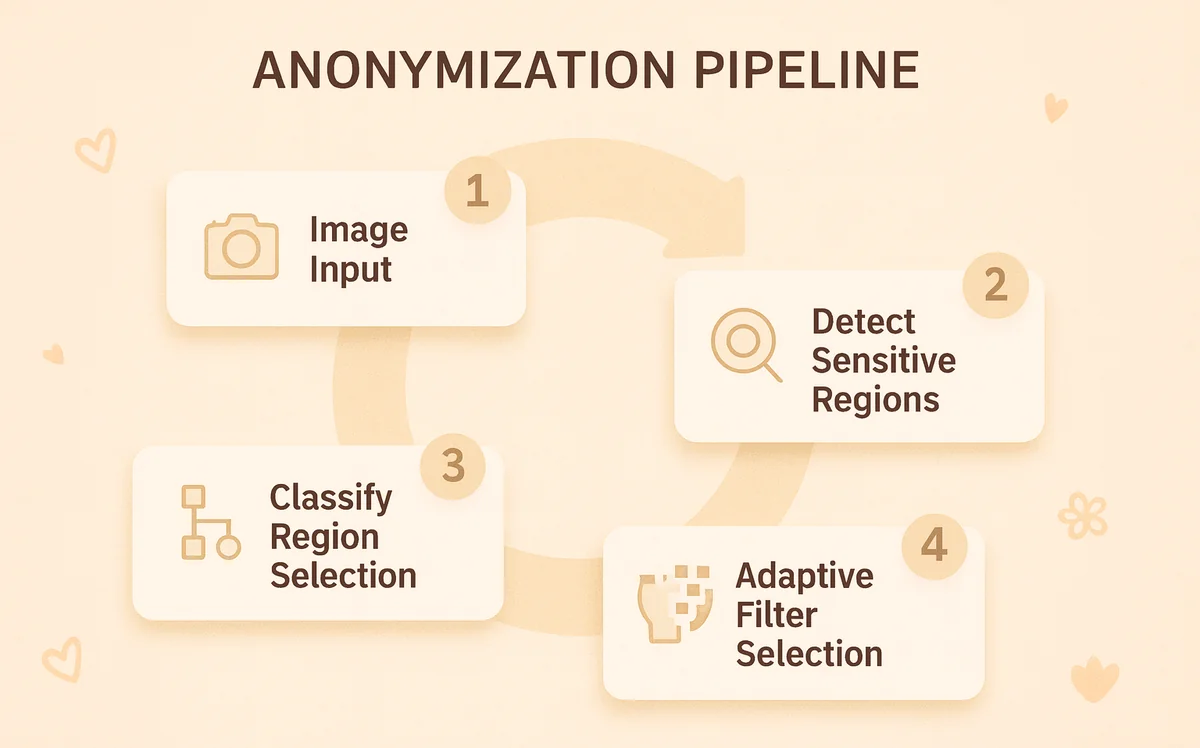
System Context & Value Proposition
The Deep Adaptive Image Anonymizer (DAIA) is an intelligent computer vision pipeline built to solve the dilemma of image redaction: ensuring 100% privacy compliance without destroying the visual context of the scene. Rather than applying uniform, crude black rectangles, DAIA combines multi-class region proposal detectors with a trained EfficientNet-B0 deep neural network to classify sensitive regions and dynamically select optimal obfuscation filters (adaptive Gaussian blur, pixelation, or blackout).
Sharing visual datasets, surveillance footage, and document scans routinely leaks Personally Identifiable Information (PII) such as bystander faces, vehicle registrations, and ID cards.
System Architecture & Execution Flow
Input Image
      ↓
[Stage 1: Region Proposal & Detection]
(Haar Cascades, Contour Analysis, Heuristic Edge Extractors)
      ↓
Candidate Bounding Boxes (Faces, License Plates, ID Cards, Signatures)
      ↓
[Stage 2: Deep Classification (EfficientNet-B0)]
(Model checkpoint: EfficientNetB0_best.pth / ONNX)
      ↓
[Stage 3: Adaptive Filter Selection]
├── Facial Region → Contextual Gaussian Blur (Radius proportional to distance)
├── License Plate → Dynamic Pixelation Grid
└── Sensitive ID Text → Total Blackout Masking
      ↓
Final Anonymized Output Image
Multi-Tier Architectural Layers
OpenCV, Haar Cascades, Edge Detectors
Locates spatial coordinates for facial landmarks, vehicle registration plates, document alphanumeric blocks, and handwritten signatures.
PyTorch, EfficientNet-B0
Custom-trained deep convolutional network classifying candidate image patches into fine-grained PII categories with high confidence.
OpenCV NumPy Matrix Transforms
Applies targeted pixelation, scaled Gaussian kernels, or alpha-blended masking while maintaining image edges and unredacted backgrounds.
ONNX Runtime, Multiprocessing
Enables hardware-accelerated batch directory processing on GPU servers without heavyweight Python deep-learning runtimes.
Core Engineering Modules & Workflows
Simultaneously isolates facial bounding geometries, vehicle license plates, ID cards, and handwritten document signatures.
EfficientNet-B0 model evaluates target sensitivity and visual context to pick the optimal obfuscation algorithm dynamically.
Multi-threaded image processing pipeline leveraging CUDA tensor operations for high-volume enterprise document redaction.
Applies non-linear pixel destruction preventing algorithmic de-blurring or reconstruction attacks.
Pre-trained weights exported to cross-platform ONNX format for deployment across Linux, Windows, and embedded edge devices.
Persistence Schemas & Execution Contracts
Database Schema & Entity Structure
Training Dataset Architecture:
  ├── Car License Plate Dataset (DatasetNinja)
  ├── Mendeley Global License Plate Dataset
  ├── Synthetic USA Driver License Dataset (Kaggle)
  └── CelebA Human Face Dataset (Kaggle)
Model Artifacts:
  ├── models/EfficientNetB0_best.pth (PyTorch Weights)
  ├── models/EfficientNetB0_last.pth (Checkpoint)
  └── models/efficientnet_adaptive_masker.onnx (Inference Engine)
Key Endpoints & Query Interfaces
Engineering Challenges & Specifications
Technical Obstacles Solved
Resolution: Tuned mathematical kernel radii proportional to bounding box resolutions and layered pixel permutation passes to eliminate deconvolution attacks.
Resolution: Fine-tuned EfficientNet-B0 with negative background hard-mining samples, increasing detection precision to > 96%.
Technology Stack Matrix
| Category | Tooling & Frameworks |
|---|---|
| Language | Python 3.10 |
| Deep Learning | PyTorch, Torchvision |
| Neural Network Architecture | EfficientNet-B0 |
| Computer Vision | OpenCV (cv2) |
| Export Format | ONNX Runtime |
| Hardware Acceleration | NVIDIA CUDA 12.4 |